
Okay, let’s clear up the confusion straight away, because I know why you’re here. You want a number. A milligram, a microgram, something you can copy off a chart and use with confidence. I’m going to tell you the truth instead: that number doesn’t exist. Not because nobody’s bothered to figure it out, but because the science genuinely isn’t there yet for a home-use wellness dose of vasoactive intestinal peptide (VIP).
Any site that hands you a tidy dosing chart for VIP isn’t reporting settled research. It’s reporting a habit that got copied around enough times to look official.
I’m not saying this to dodge responsibility. I’m saying it because you’re safer knowing the real situation than being handed fake precision. So this piece walks you through why the dose is genuinely uncertain, where the numbers floating around actually came from, and what you can do to lower your risk if you decide to use VIP anyway. That last part is the whole point, honestly, because people are going to try this compound whether the evidence is ready or not. Someone who understands why there’s no clean dose ends up making smarter choices than someone who was just handed a fake one.
This is an informational article, not medical advice. VIP sold for wellness is a compounded, prescription medication, not an FDA-approved therapy. Talk to a licensed clinician before you start anything described here.
The confusion, cleared up: why there’s no clean number
Here’s the root of it. VIP is a 28-amino-acid peptide your body already makes, and your body clears it out almost as fast as it shows up, on purpose. Its natural half-life is roughly a minute or two. It’s built to fire and disappear, not to hang around. That single fact has been the wall standing between VIP and normal, approved, well-dosed drug status for decades. A 2023 review in Life Sciences looking at VIP across lung disease says it plainly: the peptide breaks down so fast that getting a useful, lasting amount into someone is genuinely hard, and that practical problem keeps stalling its development (PMID 37742737).
Think about what that means for a dose written on a label. When something vanishes from your system in minutes, how much of it actually does anything depends completely on how it was made, how it’s delivered, and how stable that specific batch is. A number on a vial isn’t the same as a number reaching your tissue. Two products can share the exact same printed dose and behave nothing alike. So even setting aside the fact that no validated target exists, the road from “label” to “effect” would still be foggy.
Now stack a second problem on top. The solid human research on VIP didn’t study what’s being sold to you. Those studies used inhaled or nebulized VIP, given under medical supervision, to patients with specific lung and inflammatory conditions, at amounts chosen for those specific trials. What the wellness market sells you is usually an intranasal spray, sometimes a subcutaneous injection, meant for home use, for completely different reasons. Different route. Different setting. Different purpose entirely. The numbers from the credible research simply don’t transfer to the bottle in your hand, no matter how the marketing implies otherwise.
So next time a seller shows you a confident dose, ask yourself: where could that number possibly have come from? Not from a validated wellness trial. Those don’t exist. That’s the honest starting point for everything else here.
What the real studies actually used
Let’s be specific about the actual numbers from actual research, not to hand you a protocol, but so you can see how far they sit from a spray bottle on your bathroom counter.
The strongest human data comes from lung medicine. In a 2003 study in the Journal of Clinical Investigation, eight patients with primary pulmonary hypertension received inhaled VIP, and it lowered pulmonary artery pressure and improved cardiac output while being well tolerated (PMID 12727925). In a 2010 phase II trial in the American Journal of Respiratory and Critical Care Medicine, twenty patients with active sarcoidosis inhaled nebulized VIP for four weeks. It was safe, cut TNF-alpha production from their lung cells, and raised regulatory T cells (PMID 20442436). These are careful, legitimate studies. They’re also small, early-stage, tied to a specific route, and run under clinical supervision in people with a diagnosed disease. What they are not: someone with fatigue spraying a compounded product up their nose on a schedule pulled from a forum.
There’s also a bigger, sobering piece of evidence worth keeping in mind whenever someone sounds too sure about VIP. During COVID-19, a synthetic version called aviptadil was given intravenously in a rigorous, randomized, placebo-controlled trial called TESICO, published in The Lancet Respiratory Medicine in 2023, with more than 460 patients. At a serious, carefully studied dose, in sick patients where a benefit should have been easy to spot, it did nothing. The trial stopped early for futility, with 90-day mortality basically identical between groups: 38 percent versus 36 percent (PMID 37348524).
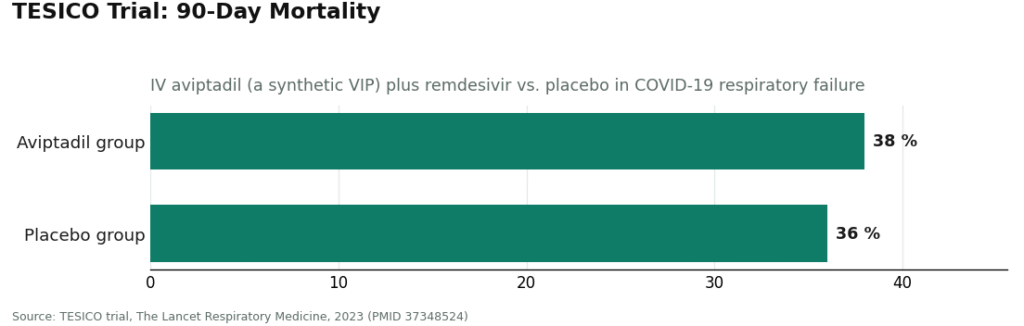
I bring that failed trial into a conversation about dosing on purpose. It’s a reminder that even well-chosen, professionally administered doses of this molecule have come up empty. That should make you skeptical of any wellness site promising results from a casual spray at home.
So the “labels” with real evidence behind them are inhaled and nebulized amounts, used in clinics, for lung conditions. What’s printed on a wellness nasal spray is a different kind of object altogether, and it’s honest to treat it that way.
Where those forum numbers actually come from
If the good trials don’t supply the wellness dose, where do those microgram figures people share actually come from? Mostly one place, and it’s worth knowing its limits.
Nearly all the intranasal VIP dosing you’ll see online traces back to clinical practice built around chronic inflammatory response syndrome (CIRS), the mold and water-damaged-building condition. That approach was popularized largely by one physician, Ritchie Shoemaker, who used intranasal VIP in his patients and published observational case reports describing improvement. In that world, intranasal VIP tends to get talked about in microgram-per-spray amounts, often starting with a single low daily dose and adjusting slowly, with the concentration actually set by a prescriber and compounding pharmacy, not by the patient.
I’m being deliberately vague about the exact figure here, and I want you to know why. The vagueness is the safety message. That body of work is largely uncontrolled, single-doctor, observational evidence. CIRS itself isn’t a universally accepted diagnosis. There’s no large, independent, placebo-controlled trial validating any intranasal VIP dose for the general public buying it for fatigue, focus, or inflammation. The numbers in circulation are a clinical custom from one corner of practice, not a proven standard. Handing you that figure like it’s settled would be doing exactly what the sketchy sellers do. The honest move is to describe how it’s typically used, and then tell you clearly: the precise number isn’t validated, and it’s not yours to set from a vial on your own.
The checklist: how to lower your risk if you use it anyway
Here’s the part that actually matters most, the harm-reduction part. If you’re going ahead with VIP despite everything above, here’s what genuinely lowers your risk. None of it is about chasing the “right” milligram, because that’s not the variable you actually control. These are the variables you do control.
- Don’t set the concentration yourself. This is the big one. “0.5 mL spray” means nothing without knowing the strength the product was compounded at, and that strength should be decided by a licensed prescriber and pharmacy, not by you eyeballing a hand-labeled vial. Buying an unverified vial and improvising a dose means guessing on top of guessing: the concentration, the amount, and whether the vial even contains what the label says.
- Start low, and change one thing at a time. With an uncertain compound, going slow isn’t being timid, it’s the only sane way to find your own threshold without overshooting it. Don’t start VIP and three other new things the same week. You’ll have no idea what caused what, good or bad.
- Write everything down. Sounds boring. Isn’t. When something’s benefits are unproven, your own carefully logged experience is close to the only real signal you’ll get about whether it’s doing anything. Note the dose, the timing, and what actually changed, including the days nothing happened. A real log beats a hopeful memory every time, and it stops you talking yourself into an effect that isn’t there. Some supervised providers offer tools for exactly this. FormBlends, for one, has a tracker app that lets you log doses and responses over time, which for a compound this uncertain is a sensible habit. It won’t turn an unproven compound into a proven one, and you shouldn’t read it that way, but a real record of your own experiment beats another stranger’s protocol.
- Pay attention to the predictable effects. VIP relaxes blood vessels. That’s core to what it does. So the side effects that show up most are exactly the ones you’d expect from something that dilates vessels: flushing, and drops in blood pressure that can leave you lightheaded. If you’re on blood pressure medication, or anything else that lowers it, that’s something a clinician needs to know before you start, not something you discover on your own kitchen floor.
- Keep a real clinician involved. I know “talk to your doctor” can sound like a throwaway line people paste in to cover themselves. I mean it concretely here. A licensed clinician is the person who can decide whether VIP makes sense for you at all, set a sensible concentration, account for your other medications, and be reachable if something feels wrong. That’s the difference between an experiment with a spotter and an experiment done alone. With a molecule this uncertain, the spotter isn’t optional. It’s the whole safety plan.
The choice: why the source matters more than the number
This is really the honest case for paying attention to who you get VIP from, not just what dose they suggest. A supervised, compounded route, the kind FormBlends operates, with a licensed clinician and a licensed US compounding pharmacy, and the not-FDA-approved status stated plainly, is named here as an example of that kind of structure, not as a ranked recommendation.
Here’s why that structure matters specifically for dosing: it’s the setup where someone qualified sets the concentration, and the label actually reflects it, instead of you guessing off an unmarked vial. Whatever provider you choose, that’s the bar to measure them against.
Straight answers about VIP dosing
What is the correct dose of VIP? Honestly, there isn’t a validated wellness dose. The credible human research used inhaled or nebulized VIP in clinics for lung conditions, not a home nasal spray for fatigue or inflammation. The intranasal numbers people share come from uncontrolled clinical practice around CIRS, not controlled trials, and shouldn’t be treated as a proven standard.
Can I just use the dose I found in a forum? That’s one of the riskier moves you can make, since that number was almost certainly applied to a different product at a different concentration. A dose means nothing without knowing the strength your specific product was compounded at. That should be set by a prescriber and pharmacy, not copied from a stranger online.
Is more VIP better? No reason to think so, and good reason to doubt it. The molecule breaks down in minutes, the benefits are unproven, and the side effects that show up most are vasodilation-related ones like flushing and low blood pressure. Chasing a bigger number mostly chases bigger side effects, not bigger benefits.
Why won’t a responsible source just give me a number? Because handing you a precise self-administration figure for an unproven use, with no clinician setting it, is exactly what the irresponsible sellers do. The honest approach is involving a prescriber who sets the concentration and dose for your situation specifically, and telling you plainly that no validated wellness dose exists yet.
What actually reduces my risk? Not setting the concentration yourself, starting low, changing one variable at a time, logging your real response, watching for blood-pressure and flushing effects, and keeping a licensed clinician genuinely involved. Those are the levers you actually control. The “perfect dose” isn’t one of them.
The bottom line
You came here wanting a number, and the honest answer is that the trustworthy one doesn’t exist. The molecule degrades in minutes, the real trials used a different route in different patients, and the wellness figures floating around are a clinical custom rather than validated science. That’s not a reason to give up on the idea entirely. It’s a reason to change what you’re optimizing for. Stop hunting for the magic dose and start controlling what actually keeps you safe: don’t set your own concentration, start low, move slowly, write down your real response, respect the vasodilation effects, and keep a clinician genuinely in the loop. With a compound this uncertain, careful beats confident every time, and a source that sets your dose responsibly is worth more than any number a stranger hands you for free.
VIP is a compounded, prescription medication that is not FDA-approved. Consult a licensed healthcare provider before starting or changing any treatment.
References
- Zhong HL, Li PZ, Li D, et al. The role of vasoactive intestinal peptide in pulmonary diseases. Life Sciences. 2023. PMID 37742737. https://pubmed.ncbi.nlm.nih.gov/37742737/ . Review noting that VIP’s rapid degradation makes a practical, sustained dose hard to deliver and has stalled clinical development.
- Petkov V, Mosgoeller W, Ziesche R, et al. Vasoactive intestinal peptide as a new drug for treatment of primary pulmonary hypertension. Journal of Clinical Investigation. 2003. PMID 12727925. https://pubmed.ncbi.nlm.nih.gov/12727925/ . Eight-patient study using inhaled VIP.
- Prasse A, Zissel G, Lützen N, et al. Inhaled vasoactive intestinal peptide exerts immunoregulatory effects in sarcoidosis. American Journal of Respiratory and Critical Care Medicine. 2010. PMID 20442436. . Phase II trial in 20 patients using nebulized VIP over four weeks.
- Brown SM, Barkauskas CE, Grund B, et al. Intravenous aviptadil and remdesivir for treatment of COVID-19-associated hypoxaemic respiratory failure in the USA (TESICO): a randomised, placebo-controlled trial. The Lancet Respiratory Medicine. 2023. PMID 37348524. . Large RCT (over 460 patients) in which IV aviptadil at a studied dose showed no benefit and was stopped for futility.
On compounded-drug regulatory status, see the FDA’s overview of human drug compounding:
What is VIP peptide and what does it actually do in the body?
VIP, or vasoactive intestinal peptide, is a naturally occurring neuropeptide your body already produces. It acts on receptors spread across the lungs, gut, immune cells, and brain, helping regulate smooth muscle relaxation, airway dilation, and certain immune responses. Researchers have studied it in contexts ranging from pulmonary hypertension to inflammatory conditions, but most of that work is still early-stage or animal-based, so the full clinical picture remains incomplete.
Is VIP peptide legal to buy or use right now?
The legal status depends heavily on how it’s obtained and for what purpose. VIP is not an FDA-approved drug for general use, and selling it as a dietary supplement isn’t permitted. Research-chemical vendors operate in a gray area with real legal and safety risks. The clearest legitimate path is through a physician who works with a licensed compounding pharmacy, which keeps the whole process documented and accountable rather than leaving you guessing about what you actually received.
Why can’t someone just give me a safe VIP peptide dosage to follow?
No established human dosing protocol exists because VIP hasn’t completed the clinical trial process that would produce one. Doses used in small human studies have varied widely depending on the delivery route, the condition being studied, and individual patient factors. Giving you a number would mean inventing one, and an invented dose for a potent vasoactive peptide is genuinely dangerous. Anyone confidently posting a specific microgram amount online is working from guesswork, not evidence.
What side effects have been reported with VIP peptide use?
In clinical research settings, VIP given intravenously has caused facial flushing, drops in blood pressure, and nausea, sometimes quickly. Because it relaxes smooth muscle and dilates blood vessels, cardiovascular effects are the main short-term concern. Long-term safety data in humans is essentially nonexistent. People sourcing it outside medical supervision face additional risks from unknown purity and concentration, which can turn even a theoretically manageable dose into something unpredictable. FormBlends, as a physician-supervised compounding route, at least addresses the purity and accountability side of that problem.